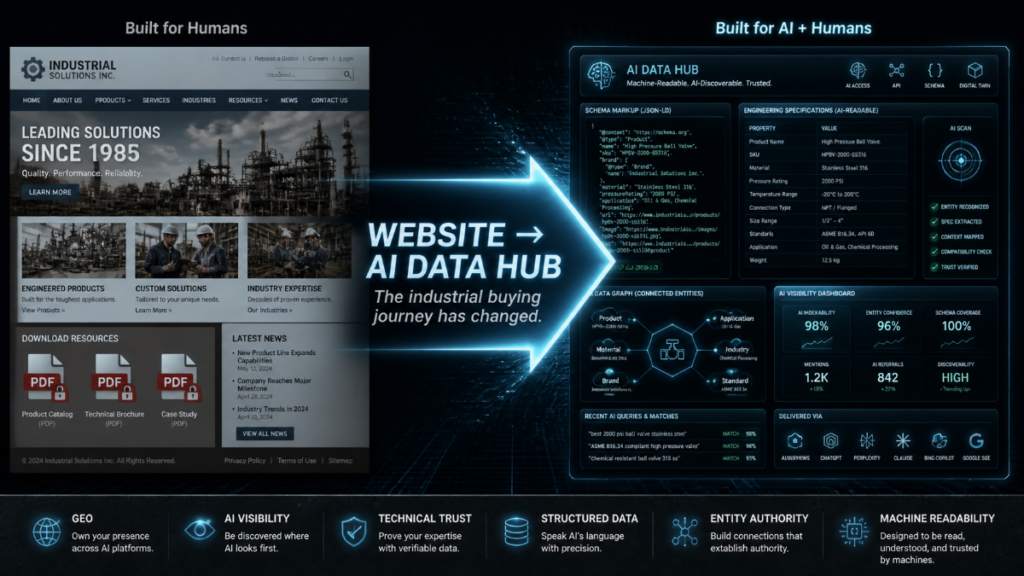
Industrial SEO is changing faster than most engineering and manufacturing companies realize.
Most industrial companies still think they’re competing for Google rankings.
They’re not.
They’re competing to become machine-readable.
Because increasingly, the first “buyer” evaluating your company is not a human engineer.
It’s an AI system.
AI procurement agents. AI search engines. Answer engines. AI-assisted sourcing platforms.
The industrial buying journey is quietly shifting from:
Human Search → Website → Vendor Evaluation
to:
AI Evaluation → Vendor Shortlist → Human Contact
And most industrial companies are completely unprepared for it.
Why Industrial SEO Is Changing
This shift is fundamentally changing how industrial SEO works in engineering and manufacturing markets.
Industrial buyers are changing how they research vendors, compare technical solutions, and build shortlists.
They are using:
- AI search engines
- procurement automation platforms
- answer engines
- technical AI assistants
- AI-generated comparisons
to compress the buying journey before a salesperson is ever contacted.
That means your website is no longer just a marketing asset.
It is becoming a machine-readable data source that AI systems can:
- interpret
- compare
- classify
- validate
- and recommend.
The uncomfortable truth is this:
Many industrial companies are still optimizing for an old search model that rewards clicks.
But the market is rapidly moving toward systems that reward:
- retrievability
- semantic clarity
- structured data
- technical trust
- entity authority
The companies that adapt early will become significantly more visible to both AI systems and human buyers.
The companies that don’t will slowly disappear from consideration.
The Industrial SEO Problem
Most industrial websites were built to impress humans.
Not machines.
They rely heavily on:
- stock photography
- vague messaging
- image-based technical specs
- gated PDFs
- complex navigation
- flashy animations
- thin product pages
In the traditional SEO era, that was acceptable.
Buyers would manually:
- search
- browse
- compare
- and eventually submit a contact form.
That model is breaking.
AI systems do not browse websites the way humans do.
They extract:
- entities
- specifications
- tolerances
- certifications
- semantic relationships
- technical evidence
- application relevance
to determine which vendors deserve visibility.
If your technical expertise is buried inside PDFs or inaccessible layouts, AI systems may not fully understand:
or why your company should be recommended.
what you sell
who you serve
where your expertise applies
How AI Is Changing Industrial SEO
The modern industrial buyer no longer starts from zero.
In many cases, the buyer already arrives with a shortlist shaped by:
- AI-assisted research
- answer engines
- peer validation
- technical comparisons
- automated procurement systems
That means the first “conversation” increasingly happens between AI systems and your website.
Not between a salesperson and a buyer.
AI-Assisted Vendor Shortlisting in Industrial SEO
Procurement teams are using AI to:
- accelerate supplier discovery
- compare vendors faster
- reduce manual research
- identify compliance alignment
- evaluate specifications
The vendor that is easiest for AI systems to interpret often enters the shortlist first.
Not necessarily the vendor with the biggest marketing budget.
Technical Research Behavior and Industrial SEO
Engineers and technical buyers now expect immediate answers to highly specific questions.
They increasingly use AI search tools to ask:
- tolerance limits
- standards compliance
- material compatibility
- operating conditions
- certification requirements
- application suitability
If your website cannot answer those questions clearly and structurally, AI systems are more likely to ignore it.
Data and Market Trends
Several major shifts are accelerating the transition toward AI-driven industrial discovery.
Recent industry research shows:
- AI-driven search traffic is growing rapidly across technical and B2B sectors
- Traditional click-through rates are declining as AI-generated answers replace blue-link browsing
- Procurement teams increasingly use AI-assisted vendor evaluation workflows
- Industrial AI adoption is accelerating across manufacturing, infrastructure, and engineering sectors
- Technical trust signals are becoming more influential in AI-generated recommendations
According to McKinsey & Company AI Insights, AI adoption in industrial and manufacturing sectors continues to accelerate as companies invest heavily in operational intelligence and automation.
At the same time, platforms like Google AI Overviews and Perplexity AI are fundamentally changing how technical buyers retrieve and compare information online.
The implication is significant: Industrial websites are evolving from digital brochures into machine-readable knowledge systems.
The Industrial AI Visibility Stack for Industrial SEO
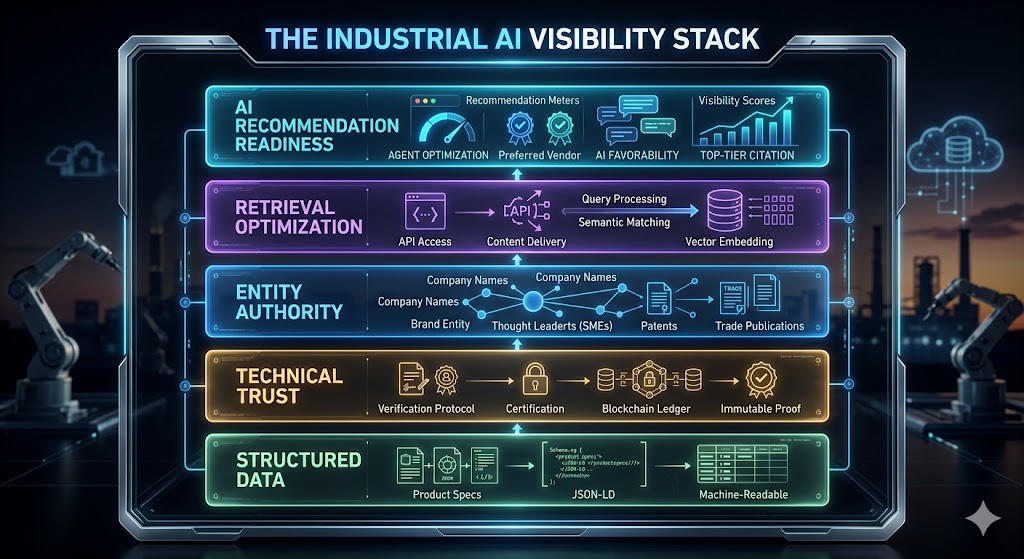
Industrial AI visibility is no longer built through keywords alone. It now depends on what I call:
The Industrial AI Visibility Stack
1. Structured Data
Can AI systems interpret your products and services clearly?
2. Technical Trust
Do your pages contain measurable proof? Structured data frameworks are now foundational for industrial GEO optimization.
3. Entity Authority
Does your company connect clearly to recognized industries, standards, certifications, and applications?
4. Retrieval Optimization
Can AI systems easily retrieve and summarize your information?
5. AI Recommendation Readiness
Would an AI system confidently recommend your company in a procurement workflow? This is the future layer sitting on top of traditional SEO.
Traditional Industrial SEO vs AI-Readable Websites
Modern industrial SEO now depends heavily on structured data, technical depth, and machine readability. Industrial websites now need to function as AI-readable technical ecosystems. Many companies now require industrial website optimization strategies built specifically for AI retrieval.
Industrial website optimization
| Traditional Industrial Website | AI-Readable Industrial Website |
|---|---|
| Brochure-style homepage | Entity-rich homepage with technical clarity |
| Gated PDFs | Crawlable HTML technical documentation |
| Image-based spec sheets | Structured specification tables |
| Generic “About” pages | Clear certifications and proof systems |
| Keyword-heavy copy | Semantic entity relationships |
| Design-first UX | Retrieval-first UX |
The difference is not cosmetic.
AI-readable websites make it dramatically easier for AI systems to:
- classify expertise
- compare vendors
- validate authority
- surface recommendations
- and generate procurement insights.
That is becoming a major competitive advantage.
The Industrial SEO Problem
Many industrial companies are losing AI visibility for surprisingly simple reasons. Most discoverability issues are identified during a technical AI visibility audit.
Gated PDFs
PDFs are useful for sales enablement.
But when all critical information is trapped inside downloadable files, AI systems struggle to interpret the company effectively.
Technical information should exist in:
- HTML
- structured tables
- crawlable pages
- FAQ sections
- schema-supported content
Missing Structured Data
Without schema markup, AI systems have a harder time understanding:
- products
- industries
- services
- FAQs
- technical documents
- applications
Schema creates machine-readable relationships.
Without it, visibility weakens.
Thin Product Pages
Most industrial product pages contain:
- generic copy
- minimal specifications
- weak technical depth
- little proof
AI systems prefer pages with:
- tolerances
- materials
- standards
- certifications
- application contexts
- limitations
- engineering detail.
Over-Designed UX
When technical information is hidden beneath animations, layered navigation, and oversized hero banners, retrieval quality declines.
What looks impressive visually may look opaque to AI systems.
Weak Citation Signals
AI systems prioritize sources that appear:
- trustworthy
- current
- technically grounded
- evidence-based.
Without:
- case studies
- standards references
- expert authorship
- measurable proof
AI trust decreases.
Why Industrial SEO Is No Longer Just About Rankings
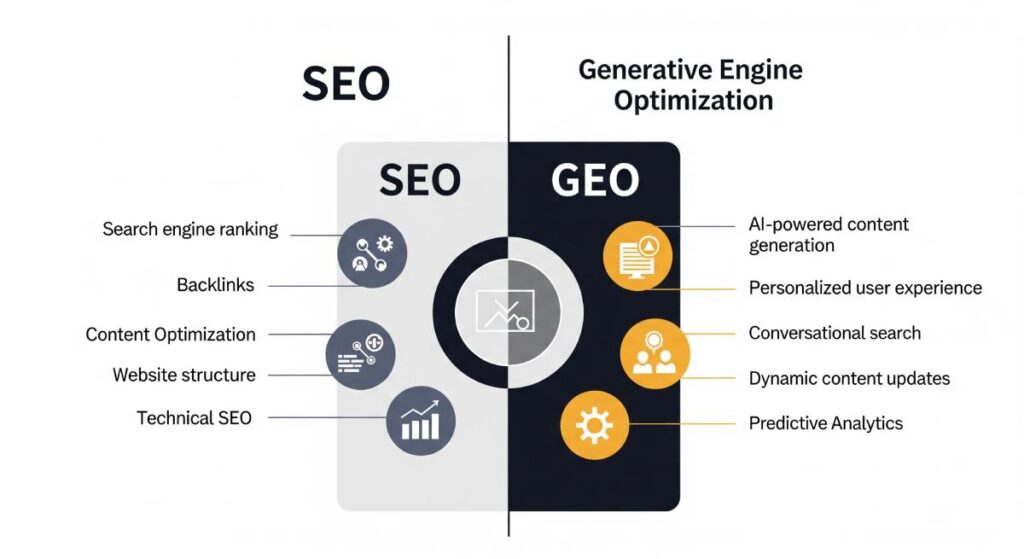
Traditional industrial SEO strategies focused primarily on rankings and clicks, while GEO focuses on retrieval, trust, and AI citations.
Generative Engine Optimization (GEO) is fundamentally different from traditional SEO.
Traditional SEO asks:
“Can we rank?”
GEO asks:
“Can AI systems understand, trust, retrieve, and cite us?”
That changes the optimization target entirely.
Traditional SEO focused heavily on:
- keywords
- rankings
- backlinks
- clicks
AI Retrieval Is Replacing Traditional Search Behavior
GEO focuses on:
- entity authority
- semantic relationships
- structured data
- retrieval quality
- machine readability
- technical trust
- AI citations
This matters because industrial discovery is moving away from blue-link browsing and toward AI-generated recommendations.
The future of industrial visibility belongs to companies AI systems can interpret fastest.
How AI Search Platforms Evaluate Content
Different AI systems behave differently.
But the pattern is remarkably consistent.
They all reward:
- clarity
- structure
- authority
- technical depth
- semantic organization
Perplexity
Perplexity is highly citation-driven.
It favors:
- structured pages
- technical explainers
- FAQs
- specification-rich content
- authoritative references.
ChatGPT Search
ChatGPT Search synthesizes information into direct answers.
If content is vague or poorly structured, it becomes harder to surface.
Gemini
Gemini relies heavily on Google’s broader information ecosystem.
Strong:
- schema
- topical authority
- semantic depth
- and entity relationships
improve visibility.
Claude
Claude rewards nuanced reasoning and detailed technical content.
Industrial firms with:
- engineering documentation
- case studies
- technical analysis
- standards references
are better positioned.
Google AI Overviews
AI Overviews are reducing the value of rankings alone.
The new competitive advantage is becoming a source AI systems choose to cite. guidance.
Why Technical Trust Matters for Industrial SEO
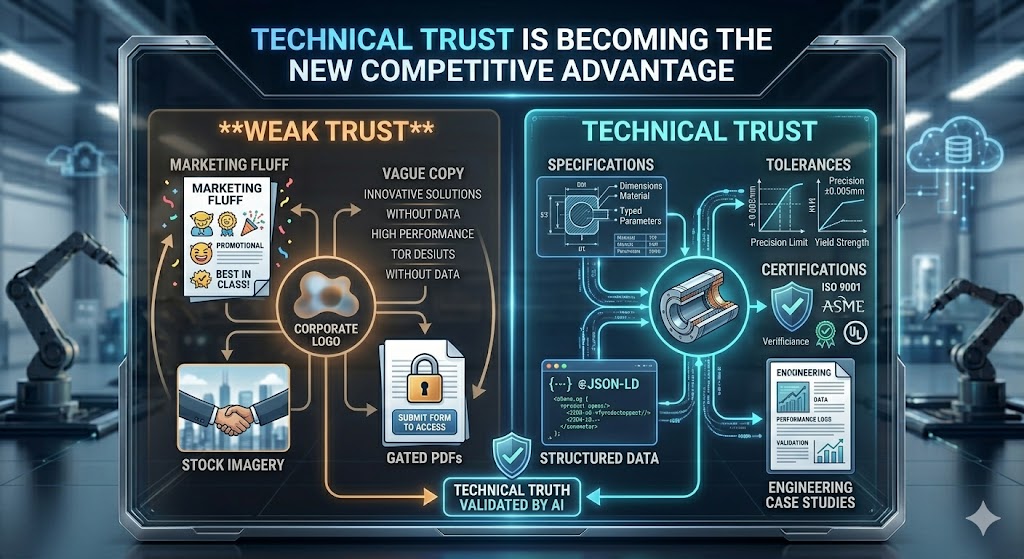
Industrial companies spent years investing heavily in branding. But AI systems do not trust branding. They trust proof. Technical trust grows significantly when engineering case studies are structured correctly.
They trust:
- measurable specifications,
- certifications,
- tolerances,
- engineering evidence,
- standards compliance,
- technical documentation,
- application clarity.
This creates what I call:
Where machine-readable expertise becomes a commercial advantage. The companies that communicate technical capability clearly – in AI-readable formats – will dominate industrial visibility over the next decade. Not because they market louder, because they are easier for AI systems to validate.
What Industrial SEO Teams Should Do Next
Industrial companies spent years investing heavily in branding.
But AI systems do not trust branding.
They trust proof.
They trust:
- measurable specifications
- certifications
- tolerances
- engineering evidence
- standards compliance
- technical documentation
- application clarity
This creates what I call:
Why Technical Trust Matters for Industrial SEO
Where machine-readable expertise becomes a commercial advantage.
The companies that communicate technical capability clearly — in AI-readable formats — will dominate industrial visibility over the next decade.
Not because they market louder.
Because they are easier for AI systems to validate.
What Technical Trust Actually Looks Like for Industrial SEO
Technical trust is built through:
- structured specifications
- measurable attributes
- standards references
- compliance documentation
- engineering case studies
- application-based pages
- expert authorship
- semantic consistency
- schema markup
When these signals exist together, the website becomes significantly easier for both AI systems and human buyers to trust.
That is the next competitive layer in industrial marketing.
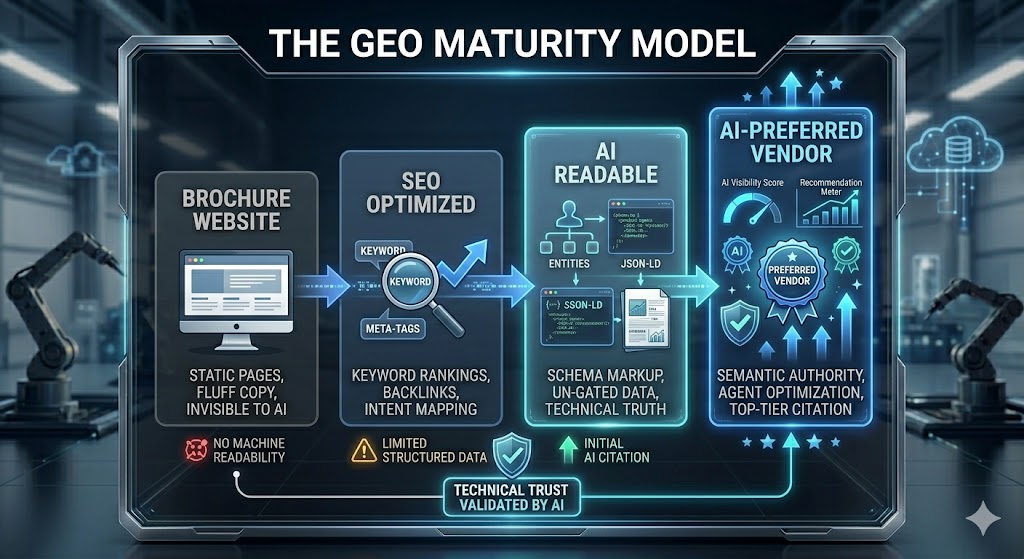
The GEO Maturity Model
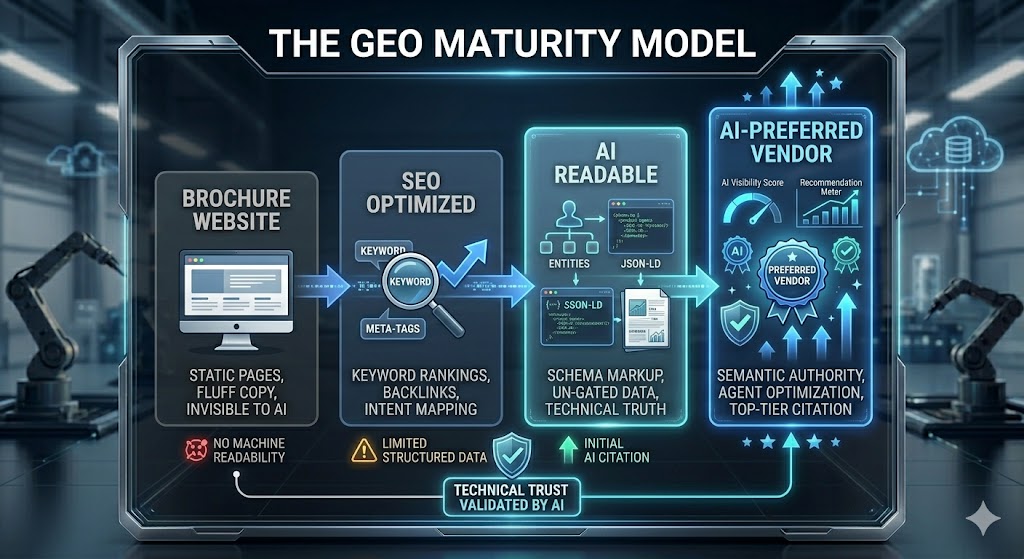
Most industrial companies currently operate at Stage 1 without realizing the market has already shifted.
The companies that adapt fastest to AI-readable systems will become significantly easier for AI platforms, procurement systems, and technical buyers to discover, trust, and recommend.
Stage 1 — Brochure Website
- Visual-first marketing website
- Generic messaging
- Gated PDFs
- Thin product pages
- Low machine readability
- Built primarily for human browsing
At this stage, AI systems struggle to fully interpret technical expertise and vendor relevance.
Stage 2 — Search Optimized
- Traditional SEO implemented
- Keyword-focused content
- Blog strategy in place
- Metadata optimized
- Basic search visibility improvements
This improves rankings, but still focuses primarily on human search behavior rather than AI retrieval systems.
Stage 3 — AI Readable
- Structured data implemented
- Schema markup deployed
- Technical documentation available in HTML
- Semantic entity relationships established
- AI retrieval optimization introduced
- Technical trust signals strengthened
At this stage, AI systems can more effectively interpret, compare, and classify the company’s expertise.
Stage 4 — AI-Preferred Vendor
- AI systems consistently retrieve and cite the company
- Strong entity authority established
- Technical trust ecosystem fully developed
- Product and specification data highly structured
- AI procurement workflows recognize the company easily
- The business becomes recommendation-ready
This is where industrial visibility is heading over the next several years.
The Future of Industrial SEO Belongs to AI-Readable Companies
The companies that reach this stage early will gain a major competitive advantage as AI-driven procurement and answer engines continue reshaping industrial search.
The future of industrial SEO belongs to companies that build AI-readable technical ecosystems instead of brochure-style websites.
Industrial companies spent the last decade optimizing for clicks.
The next decade will belong to companies optimized for retrieval, trust, and recommendation, because increasingly, the AI decides who gets considered before the buyer ever visits a website. And by the time most companies realize the shift happened, the market leaders will already be AI-preferred vendors. The future of industrial marketing belongs to the companies AI can understand fastest.
Book a free AI visibility audit.
Download The GEO Visibility Checklist
Is traditional SEO still important for industrial companies?
Yes, but traditional SEO alone is no longer enough. Industrial companies must now optimize for AI readability, structured data, technical trust, and GEO to remain visible in AI-driven search environments.
What is GEO in industrial marketing?
GEO (Generative Engine Optimization) focuses on helping AI systems understand, retrieve, and recommend your content inside AI-generated answers and procurement workflows.
Why are industrial websites becoming AI data hubs?
AI systems increasingly evaluate vendors before buyers visit websites. Industrial websites now need to function as machine-readable technical databases that AI can interpret and validate.
What is technical trust?
Technical trust refers to measurable proof signals such as specifications, certifications, tolerances, standards compliance, engineering documentation, and structured technical content.
Why does structured data matter for industrial SEO?
Structured data helps AI systems and search engines understand products, services, specifications, and technical relationships more clearly, improving retrieval and visibility.
Can AI systems read PDFs?
AI systems can partially parse PDFs, but structured HTML content is significantly easier to retrieve, classify, and cite accurately.